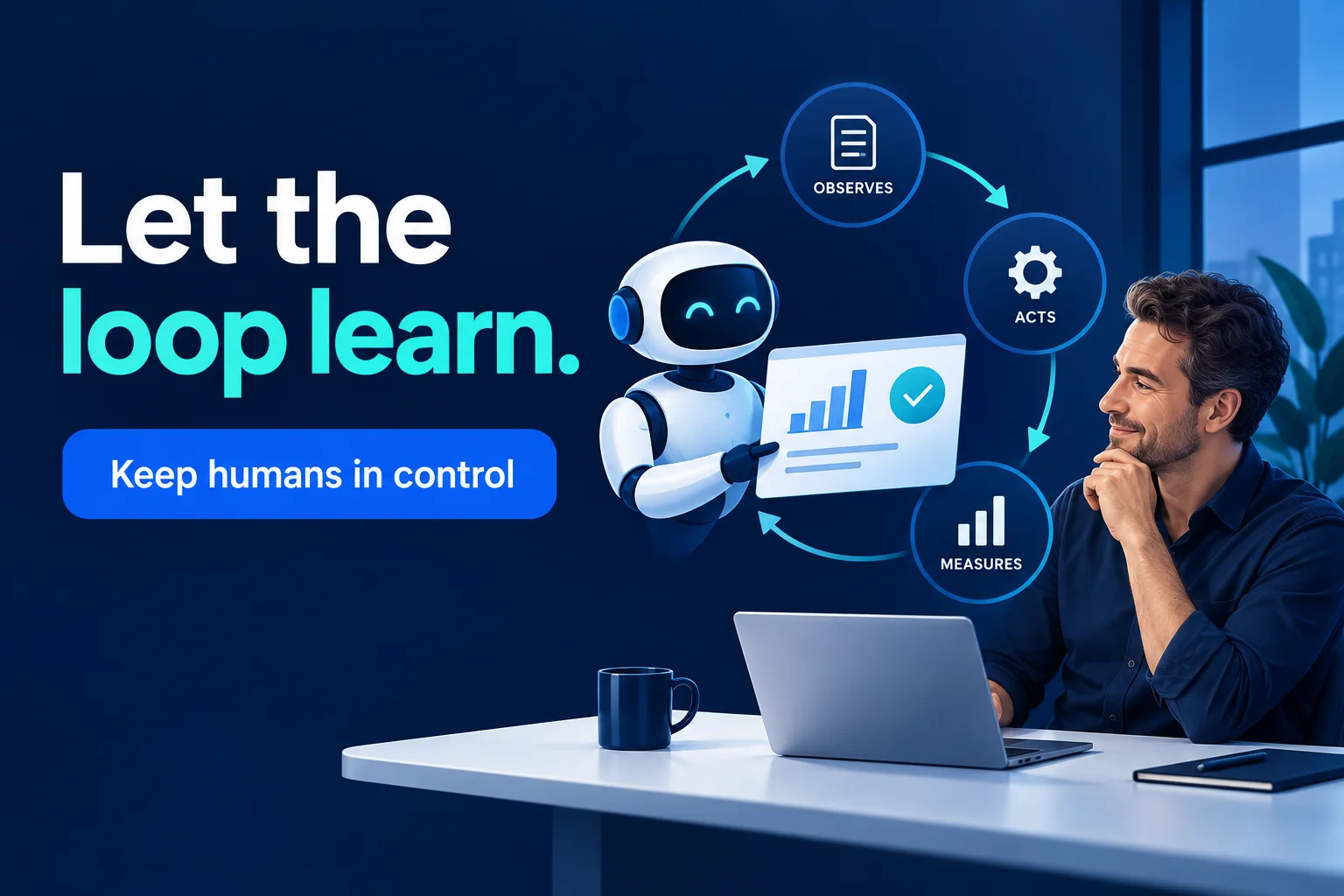
"AI agent" has been applied to everything from a chatbot with a scripted menu to a system that manages an ad account. The word is doing so much work that it has stopped carrying information - which is a problem when you are being asked to trust one with your marketing.
There is a real technical distinction underneath the marketing, and it is worth ten minutes. Once you can see the loop, you can evaluate any agent claim in about thirty seconds, and you can tell which parts of your own marketing are safe to hand over.
What an agent is not
Three things are routinely sold as agents and are not:
- A chatbot. Takes an input, returns an output, forgets. No goal that survives the exchange.
- A workflow automation. "When a form is submitted, add to CRM and send email." Enormously useful, entirely deterministic. Someone drew the whole decision tree in advance; nothing is being decided at runtime.
- A prompt chain. Research, then outline, then draft, then edit. Genuinely more capable, still a fixed sequence. It cannot decide that step two was a mistake and go back.
The common property: the path is fixed before execution. The system can be sophisticated and still have no capacity to change its own plan in response to what it finds.
The loop
An agent is a system that pursues a goal by repeating four operations until the goal is met or it stops:
- Observe. Gather the current state of the world - the live page, the ranking data, the spend, the CRM history, the result of its last action.
- Decide. Choose the next action given that state and the goal. This is the step the other three systems do not have.
- Act. Do it, using a tool - write the copy, query the API, restructure the campaign.
- Measure. Observe what changed, and feed that back into the next iteration.
The loop is the definition. Everything else is detail. And the important consequence is this: because the path is not fixed in advance, nobody - including the people who built it - knows exactly what sequence of actions a given run will produce. That is the source of both the capability and every legitimate concern about it.
A workflow that breaks does the wrong thing once, predictably. An agent that goes wrong can pursue a wrong decision through several confident iterations. This is not an argument against agents. It is an argument for knowing precisely where the loop is allowed to touch the outside world.
The three places the loop breaks
Bad observation
An agent reasoning from stale or partial state will make locally sensible decisions that are globally wrong. An agent that cannot see that you paused a campaign for legal reasons will helpfully restart it, and its reasoning will look impeccable.
Most "the AI did something stupid" stories are observation failures rather than reasoning failures. The question to ask a vendor is not how smart the model is. It is what the agent can see, and how recently.
Goals that are proxies
Agents optimise what you measure with uncomfortable literalism. Set the goal as "increase organic sessions" and publishing volume is a valid strategy. Set it as "reduce cost per lead" and disqualifying expensive good leads is a valid strategy.
Humans quietly correct for the difference between the stated goal and the intended one. Agents do not, unless the constraints are stated. Which means the constraints - what must not happen - matter more than the objective.
No bound on action
This is the one that actually hurts. An agent whose loop can publish, spend, or send without a checkpoint can iterate on a bad decision several times before anyone notices. The failure is not that it acted once. It is that the loop closed around the mistake and kept going.
The fix is not a smarter model. It is a boundary: certain actions leave the loop and enter a human queue.
The half-open loop
The design that works in practice is not "fully autonomous" and not "AI suggests, human does everything." It is a loop that runs closed for reversible work and opens for irreversible work.
The useful test is not how important the work is. It is how expensive the mistake is to withdraw:
- Cheap to reverse, internal, or time-critical - research, monitoring, listing corrections, reporting, capturing and routing an inbound lead. Close the loop. A lead that waits for approval is a lead that called a competitor; here, the delay is the risk.
- Expensive to reverse, external, or spends money - publishing a page, posting publicly, launching a campaign, moving budget, emailing a prospect list. Open the loop. A person decides.
Note what this framework does not say: that important work needs approval and trivial work does not. Answering an inbound call is important and runs autonomously. Posting a low-stakes social update is trivial and waits. Reversibility is the axis that matters.
Four questions for any agent vendor
- Which specific actions can it take without a human? A list, not a philosophy. If the answer is a sentence about "human-in-the-loop design" rather than an enumeration, there is no enumeration.
- What happens if I ignore an approval request? The right answer is "nothing ships, indefinitely." A timeout that auto-approves is an open loop wearing a costume.
- Can I see why it decided something, after the fact? If runs are not on the record, you cannot debug a bad outcome - you can only notice it.
- Can autonomy be tightened as well as loosened? Settings that only add autonomy are a ratchet.
These four questions separate genuine agent systems with real boundaries from workflow automation with ambitious marketing, in both directions.
Where we draw the line
Spryxa's crew runs the loop in six steps rather than four - the two additions are both boundaries. Between acting and handing off, Brand Steward agent reviews every artefact against your brand and claim rules and sends failures back into the loop instead of to you. Then the handoff step classifies the artefact: reversible work ships and is logged, and anything customer-facing stops and waits.
Concretely: agents publish nothing to a customer-facing surface without approval, budgets never move unattended, no approval request auto-approves on a timeout, and autonomy settings can move work into the queue but never out of it. Every run keeps its inputs, reasoning, output, and outcome on the record - including runs whose output you rejected, because a rejection is the most informative signal the loop receives.
The full action-by-action breakdown, including what happens if you do nothing, is on the agent handoffs page. It is worth reading even if you are evaluating someone else - it is the format the answer should come in.
The short version
An agent is a loop: observe, decide, act, measure. The loop is what makes it capable and what makes it risky, and the only meaningful safety question is where the loop is allowed to touch the outside world. Judge that by reversibility, not importance. And be suspicious of any vendor who answers "which actions run without me?" with a philosophy instead of a list.